
Custom vs. Stock Cabinets: What's Actually Worth the Investment?
January 29, 2026
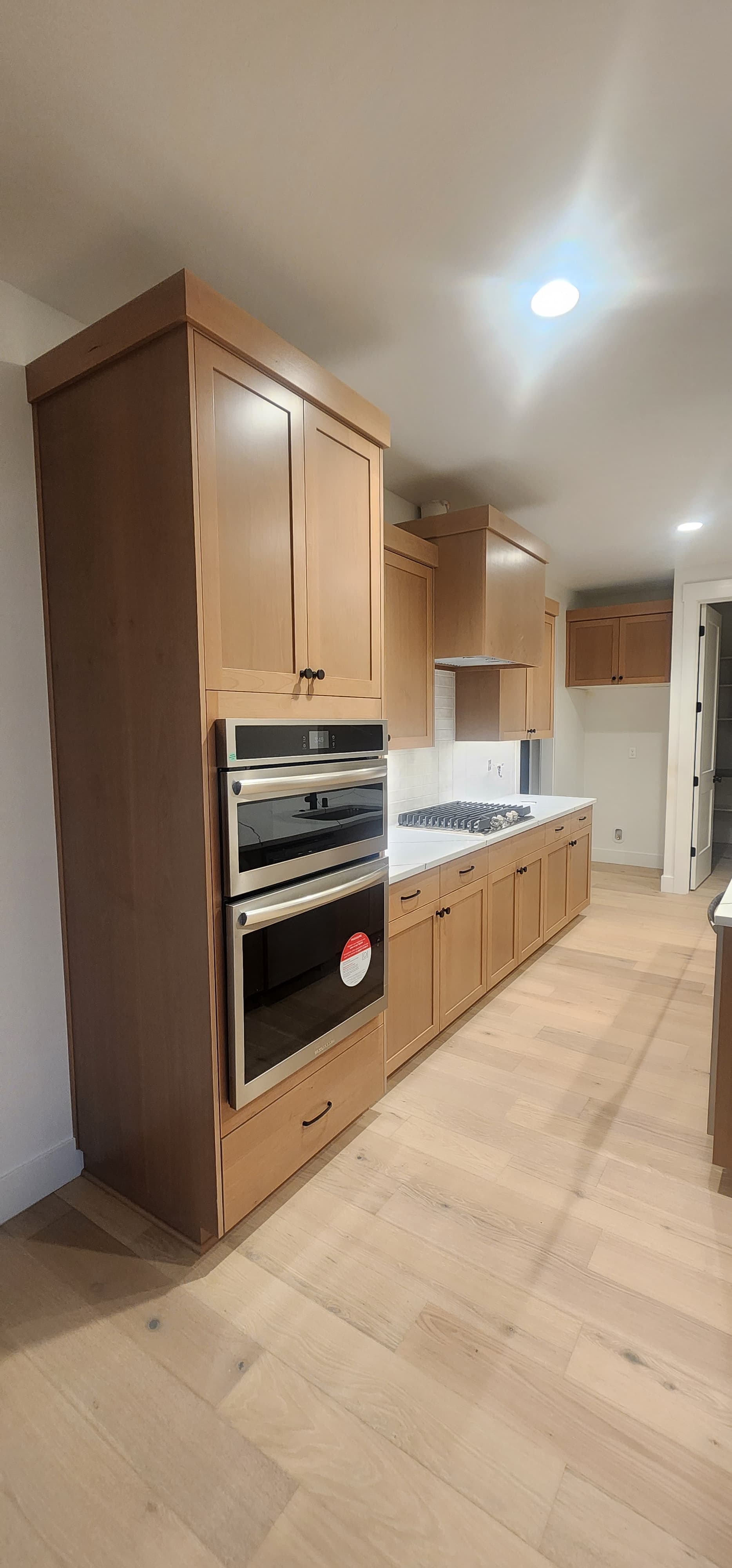
Walk into a big-box home improvement store and you can order kitchen cabinets off the shelf, in standard sizes, ready in a few weeks. So why do homeowners across the Tri-Cities and Eastern Washington still choose custom cabinetry instead? It’s a fair question, and the honest answer is: it depends on your space, your goals, and what you’re actually trying to solve. Here’s how we’d walk you through the decision if you sat down with us for a consultation.
What “Stock” and “Custom” Actually Mean
Stock cabinets are mass-produced in a limited set of standard sizes (typically 3” increments in width), standard door styles, and a handful of finish options. They’re built in bulk, warehoused, and shipped to order.
Custom cabinets are designed and built specifically for your space, exact dimensions, your choice of materials, door style, finish, storage configuration, and layout. Nothing is a “close enough” fit; everything is built to the actual measurements of your room.
There’s also a middle tier, semi-custom, which offers more size and style flexibility than stock but still works within a manufacturer’s existing system rather than a fully custom design.
Where Stock Cabinets Make Sense
We’ll say this upfront because it’s true: stock cabinets aren’t a bad choice for every situation. If your kitchen or bathroom has a fairly standard layout, you’re working with a tighter budget, and you’re not trying to solve an awkward space or maximize every inch of storage, stock cabinetry can be a perfectly reasonable option.
Where Custom Cabinets Actually Pay Off
Awkward or non-standard spaces. Older homes, angled walls, low ceilings, unusual room dimensions, or a kitchen island that doesn’t fit any standard size, this is where stock cabinetry starts requiring filler panels, gaps, and compromises. Custom cabinets are built to your exact space, so every inch is used intentionally instead of patched over.
Maximizing storage. This is one of the most common reasons people come to us. Standard cabinet depths and widths often waste usable space, corner cabinets with dead zones, gaps above refrigerators, awkward pantry proportions. Custom work lets us design storage around how you actually live: pull-out spice racks, full-extension drawers instead of shelves, appliance garages, and pantry systems built to your exact wall dimensions.
Long-term durability. Custom cabinetry gives you control over materials from the ground up, box construction, drawer glides, hinges, and finish type, rather than whatever spec a mass manufacturer chose to hit a price point. For a kitchen you’ll use every day for the next 20 years, that difference compounds.
Design cohesion. When cabinets are custom-built, door style, hardware, and finish carry consistently across your whole kitchen, vanity, or built-in, including transitions into adjacent spaces like an open-concept living area or a mudroom that flows from the kitchen.
Resale and home value. Well-built custom cabinetry is a genuine selling point in this region’s housing market, especially for buyers comparing homes at a similar price point.
The Cost Question
Custom cabinetry does typically cost more than stock, there’s no getting around that, since you’re paying for design time, made-to-order materials, and skilled labor rather than economies of mass production. But “more expensive” doesn’t automatically mean “not worth it.” The right comparison isn’t custom vs. stock in a vacuum, it’s the cost of custom cabinetry against the cost of a kitchen that doesn’t quite fit your space, doesn’t maximize your storage, or needs to be replaced sooner because it wasn’t built for the long haul.
We also find that once people account for the fillers, panels, and modifications often needed to make stock cabinets work in a real (not perfectly standard) room, the price gap narrows more than they expect.
How to Decide
A few honest questions worth asking yourself:
- Does your space have any non-standard dimensions, angles, or awkward corners?
- Is maximizing storage a priority, or do you have plenty of room to spare?
- Are you planning to stay in this home long-term, or is this a shorter-term investment?
- Do you have a specific design vision that stock options don’t quite match?
If you answered yes to more than one of those, custom cabinetry is probably worth a serious look.
Ready to talk through your project?
Book a Design Consultation