
Melamine vs. Plywood Cabinet Boxes: Which One Is Actually Better?
January 15, 2026
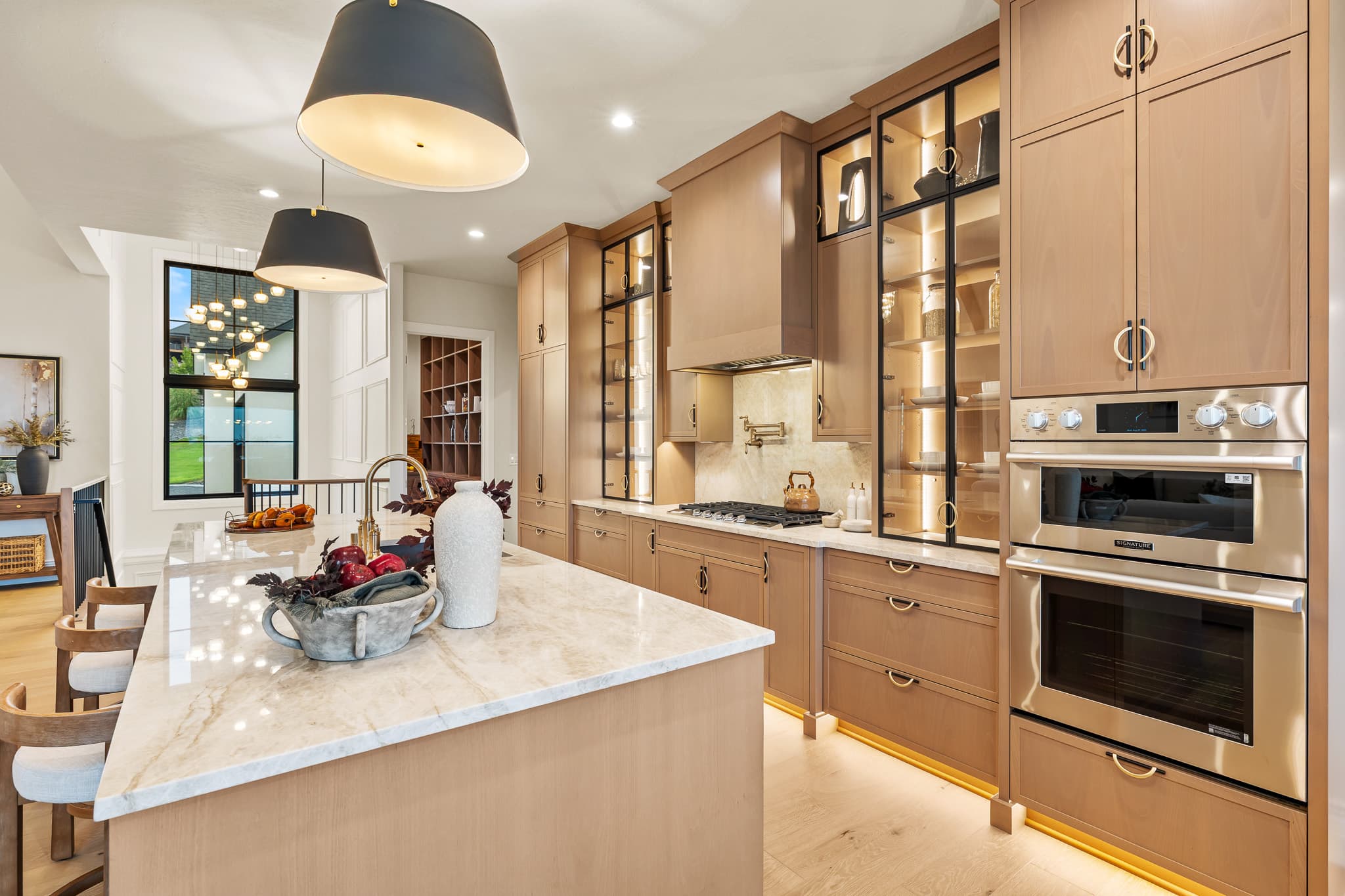
If you’ve started researching custom cabinets, you’ve probably run into this question fast: should your cabinet boxes be built from melamine or plywood? It comes up in almost every kitchen or bathroom consultation we do, and for good reason, the cabinet box (sometimes called the “carcass”) is the part of your cabinetry doing all the structural work. The doors get the attention, but the box is what holds your dishes, your clothes, and your countertop up for the next 20+ years.
Here’s an honest, no-marketing-spin breakdown of both materials, how we use them, and how to think about which one is right for your project.
What “Melamine” and “Plywood” Actually Mean in Cabinetry
Melamine in the cabinet industry almost always refers to melamine-faced particleboard or MDF (medium-density fiberboard), a core material with a thin, hard, printed layer fused to the surface under heat and pressure. That surface layer is what gives melamine its smooth, consistent, often white-interior look. It’s not the flimsy stuff you might picture from big-box furniture; commercial-grade melamine used in custom cabinetry is a completely different tier of material.
Plywood cabinet boxes are built from thin layers (plies) of real wood veneer, cross-laminated and glued together under pressure. Cabinet-grade plywood is typically ¾” for larger panels and ½” for smaller components, with grain running in alternating directions between layers for strength.
Strength and Structural Performance
This is where the differences actually start to matter for how long your cabinets last.
Plywood has a natural advantage in screw-holding strength, especially at the edges. Because the grain runs in multiple directions across the layers, plywood resists splitting when you drive a screw near an edge, which matters a lot when you’re mounting drawer slides, hinges, or attaching cabinets to walls. It also tends to hold up better over decades of humidity swings, since real wood layers move less unpredictably than a particleboard core.
Melamine, particularly the higher-density commercial grades we use, is genuinely strong for flat-panel structural use, shelving, cabinet sides, and bottoms all perform well. Where it’s more vulnerable is at cut edges and around repeated screw insertion points, especially if lower-grade particleboard core is used instead of MDF. This is why edge-banding quality matters so much with melamine, a well-banded edge protects the core from moisture and impact; a poorly banded one is where problems start.
Moisture Resistance
Kitchens and bathrooms both deal with humidity, spills, and the occasional under-sink leak nobody notices right away.
Cabinet-grade plywood, especially with a proper finish or laminate face, handles moisture exposure well because solid wood veneers don’t absorb and swell the way particleboard can. Melamine’s face material itself is actually quite moisture-resistant, that hard printed surface sheds water well, but the vulnerability is at any exposed or poorly sealed edge, where moisture can wick into the core and cause swelling over time.
Bottom line: for areas with regular water exposure (under sinks, near dishwashers, bathroom vanities), we pay close attention to edge treatment regardless of material. Melamine is our standard build material across all cabinet boxes, including these higher-moisture areas, because a well-banded edge holds up well in normal residential use. If you’d prefer plywood boxes in these areas specifically, we’re glad to build that way; it just comes as a request rather than our default.
Cost
Melamine cabinet boxes are typically less expensive than plywood, sometimes significantly so depending on the grade of plywood you’re comparing against. This is one of the most practical reasons melamine has become the standard interior material for a huge share of custom cabinetry nationally, it lets us put more of your budget toward the parts of the cabinet you actually see and touch every day: door style, finish, and hardware.
Appearance
Melamine gives a clean, consistent, factory-smooth look, which is exactly why it’s the standard choice for cabinet interiors, even in high-end kitchens. You’ll rarely see the interior of a cabinet box anyway once doors and drawer fronts are on, so this is usually a non-issue.
Plywood has a more natural look if left exposed (open shelving, glass-front cabinets, or drawer boxes where you’ll actually see the material) and takes stain more predictably than particleboard-based products.
Our Standard, and Why
At Hill Country Cabinets, we build every cabinet box with high-quality melamine as our standard material, for kitchens, vanities, built-ins, all of it. This isn’t a budget compromise; it’s a genuine, informed choice. Commercial-grade melamine with proper edge banding is strong, consistent, moisture-resistant where it counts, and lets us put more of your budget toward the parts of the cabinet you interact with daily, door style, finish, hardware, and interior organization.
That said, plywood has real advantages in specific situations, and if you have a reason to want it, heavier structural demands, a preference for solid wood construction throughout, or simply peace of mind in a particularly moisture-prone area, we’re glad to build your cabinet boxes in plywood instead. It’s not something we push by default, but it’s always an option worth discussing if it matters to you.
The best approach is talking through your specific project, how the space will be used, and what matters most to you, which is exactly what we do during a design consultation.
Ready to talk through your project?
Book a Design Consultation